
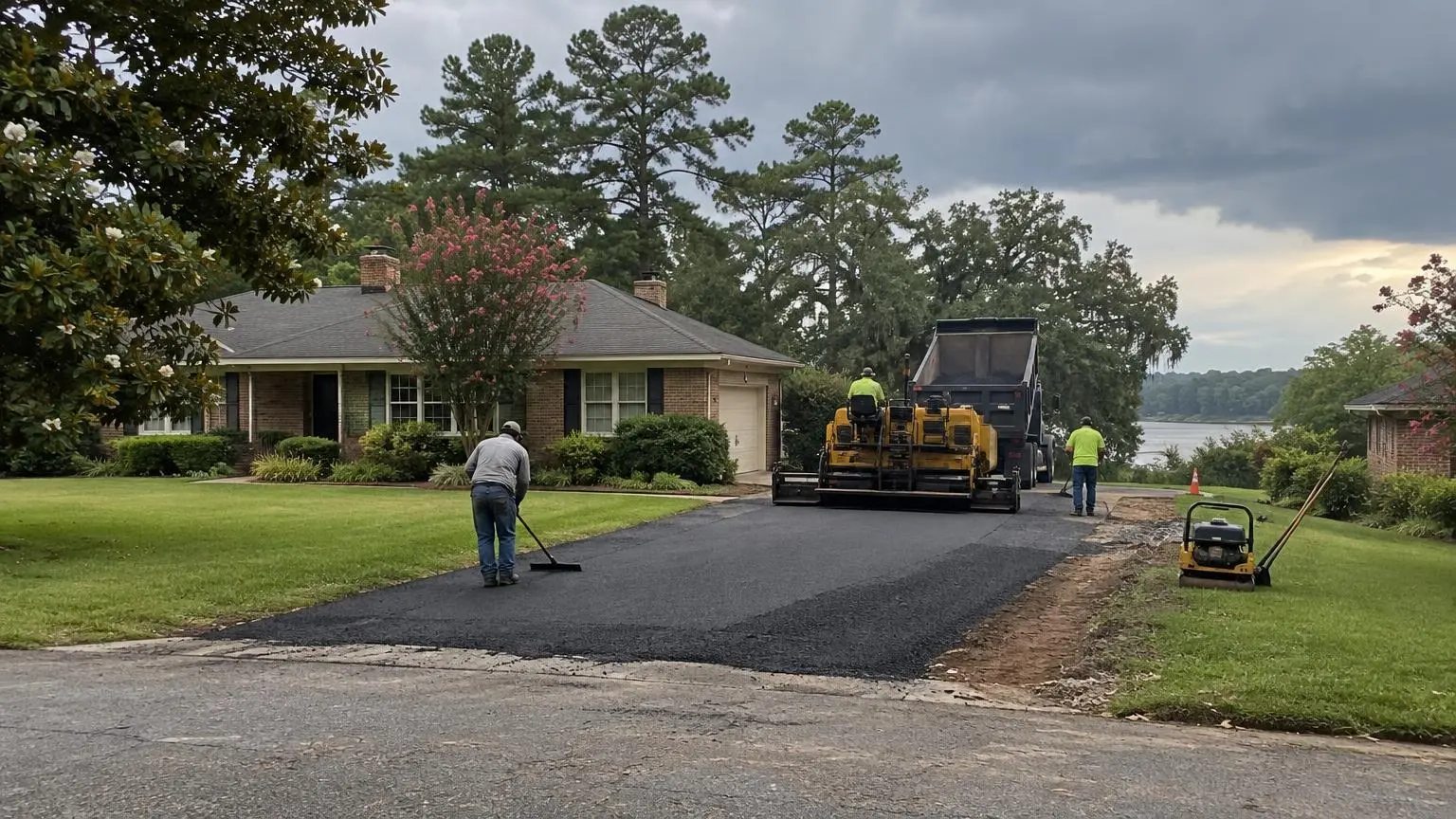
Driveways, lots and private drives across the Jackson metro
Asphalt Paving in Jackson, MS
New asphalt built for shrink-swell clay and heavy Mississippi rain, plus the repair and sealing that keeps it in shape.
- Free on-site estimates
- Itemized written quote: undercut, base depth and asphalt thickness spelled out
- MS811 locates and city, county or MDOT permit questions handled before work is scheduled
Paving on Yazoo Clay
Asphalt paving in Jackson has one problem that most cost guides never mention: the clay underneath. Much of the Jackson metro sits on Yazoo clay, which swells when it soaks up water and shrinks when it dries out. The city also averages about 57 inches of precipitation a year, well above most of the country, with dry stretches in between. Asphalt laid thin over that ground cracks, heaves and potholes early. Asphalt built on a properly prepared base can last for decades.
Why Jackson pavement fails
Yazoo clay is a montmorillonite clay, a mineral that changes volume dramatically with moisture. The Mississippi Department of Transportation has said Yazoo clay can expand to take up about 400 percent more space when wet than at normal moisture. When it dries, it pulls back and leaves voids under the pavement, and traffic eventually breaks the unsupported asphalt into cracks. A 1988 report from the state's Bureau of Geology named the clay's expansion as a primary cause of foundation and structural damage in the Yazoo clay belt, especially in Jackson.
You can see the result on city streets. In 2015 the mayor declared a state of emergency over potholes and water main breaks, with repairs estimated at $750 million to $1 billion. A Jackson State University engineering professor told the Jackson Free Press that when a road's subgrade is not stabilized, rain and heavy loads make it "rapidly deform and deteriorate," and that some Jackson roads had potholes within a year of being resurfaced.
How we build for it
MDOT's own answers to Yazoo clay on highways are to undercut and replace problem clay beneath the pavement, treat the subsoil with lime or cement, and limit clay in fill. Driveways and lots follow the same logic at a smaller scale. We proof the subgrade, dig out soft or heaving clay, and build a compacted crushed-stone base thick enough to bridge small movements in the ground. Where the clay is bad over a large area, stabilizing it is an option we price separately so you can compare.
Cost guides describe a typical residential section as 2 to 3 inches of compacted asphalt over 6 to 8 inches of gravel base, and 3 to 4 inches over 8 to 10 inches for heavier vehicles. Your quote says which section we are building and why. Thickness matters: when Robinson Road was repaved, an asphalt industry spokesman noted that the 1.5-inch overlay was thinner than the 2 to 3 inches he would have liked. The same thinking applies to your driveway.
Water and drainage
Water is what sets Yazoo clay in motion, so keeping it off and away from the pavement is half the job. We set cross slope so rain sheets off the surface, keep the low end from dumping water against a garage slab, support and backfill edges so runoff cannot get under them, and point out where a swale or a driveway pipe would help. Large lots get grades checked against their drains, since undersized or clogged inlets are a common cause of standing water and early failure around Jackson.
Weather and timing
Jackson's winters are short and mild. The January average low is about 37 degrees and snow averages well under an inch a year, so the paving season is long. Hot mix still has to be compacted before it cools, so larger jobs wait for warm, dry days. Summer brings its own issue: the record high here is 107 degrees, and fresh asphalt stays soft in July heat, so we tell you how long to keep cars, trailers and jack stands off it.
City streets, county roads and state highways
Where your driveway meets the road decides whose rules apply. Driveways connected to a state highway, such as US 49, US 51, US 80 or a state route, need an MDOT permit on its Form MND-001 before construction, and pipe culverts there must meet MDOT's design criteria. Inside Jackson, permits go through the city's online permit portal. Ridgeland, Madison, Flowood, Brandon and the other towns have their own processes, and county roads go through the county. We sort out which applies at the estimate. Before any machine digs or grades, we request utility locates through MS811, which Mississippi law requires at least two working days ahead.
What a new driveway job includes
- Measuring, checking slope and drainage, and noting the road connection
- Removing old asphalt, concrete or worn-out gravel
- Undercutting soft or heaving clay and replacing it with compacted stone
- Grading and compacting the stone base to the depth in your quote
- Placing and rolling hot-mix asphalt to the stated compacted thickness
- Tapering edges and transitions at the garage, walks and road apron
- Care instructions for the first summer and a sealcoat timeline
Where We Work
We are based in Jackson and work across the three counties of the metro. North of the city in Madison County, Ridgeland, Madison and Canton run from newer subdivisions and office parks to older town centers. East across the Pearl River in Rankin County, Flowood, Brandon, Pearl and Richland have grown fast, and many of their driveways and lots are now due for a first repair or sealcoat. West and south in Hinds County, Clinton, Byram and Terry mix established neighborhoods with long rural drives. The Yazoo clay problem shows up across the area, but drainage, lot size and the road you connect to change from town to town. Each town page below covers what is particular to that community.
- Asphalt Paving in Jackson, MS
- Asphalt Paving in Clinton, MS
- Asphalt Paving in Ridgeland, MS
- Asphalt Paving in Madison, MS
- Asphalt Paving in Brandon, MS
- Asphalt Paving in Pearl, MS
- Asphalt Paving in Flowood, MS
- Asphalt Paving in Richland, MS
- Asphalt Paving in Byram, MS
- Asphalt Paving in Canton, MS
- Asphalt Paving in Gluckstadt, MS
- Asphalt Paving in Florence, MS
- Asphalt Paving in Terry, MS
- Asphalt Paving in Raymond, MS
- Asphalt Paving in Flora, MS
- Asphalt Paving in Pelahatchie, MS
- Asphalt Paving in Crystal Springs, MS
- Asphalt Paving in Bolton, MS
- Asphalt Paving in Edwards, MS
- Asphalt Paving in Mendenhall, MS
- Asphalt Paving in Puckett, MS
- Asphalt Paving in Star, MS
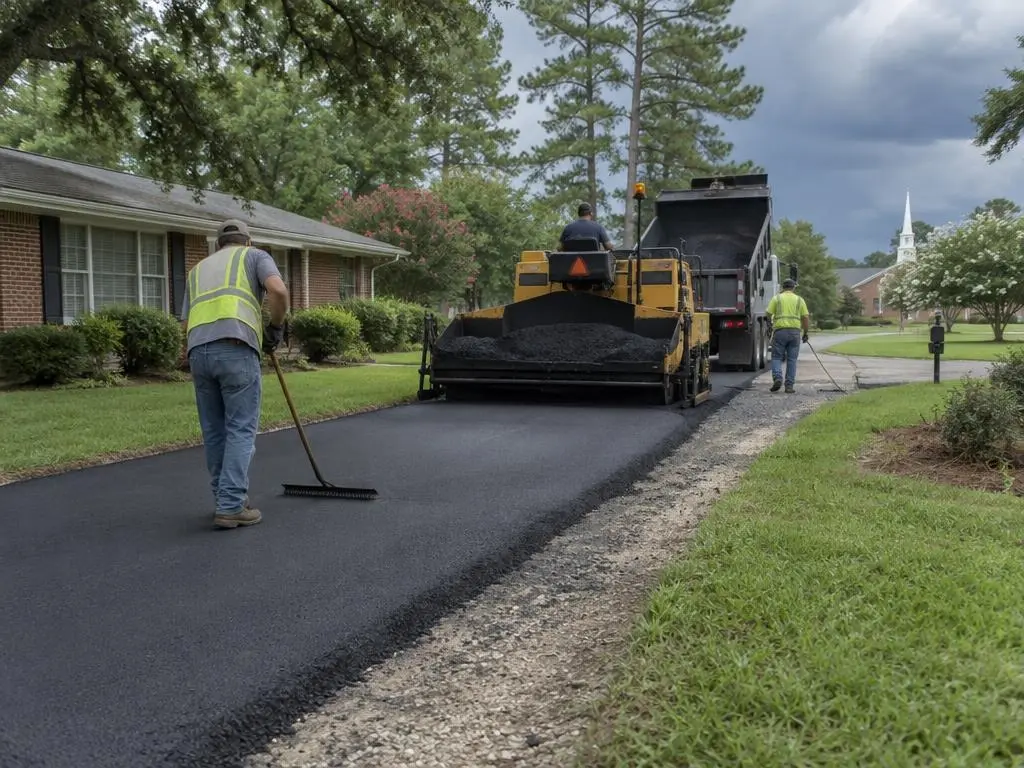
Asphalt Services Around Jackson
Six services that cover a driveway or lot from the first load of stone to the years of upkeep after it.
Asphalt Driveway Paving
New and replacement driveways built on a compacted stone base deep enough for Yazoo clay.
Learn more →Asphalt Repair
Pothole patching, crack sealing and cut-out repairs for heaved or broken sections.
Learn more →Asphalt Resurfacing
A new layer of asphalt over a sound existing surface, after the weak spots are repaired.
Learn more →Sealcoating
Protective sealer for driveways and lots, applied on dry, warm days after cracks are filled.
Learn more →Parking Lot Paving
New lots, expansions and rebuilds for businesses, churches and HOAs, with drainage and ADA layout planned in.
Learn more →Parking Lot Striping
Restriping and new layouts with ADA-compliant accessible spaces, arrows, fire lanes and curb paint.
Learn more →Common Questions
How much does it cost to asphalt a 20x20 driveway?
HomeGuide lists a 400-square-foot (20x20) asphalt driveway at about $2,000 to $4,800 nationally. Tear-out, clay undercut and drainage work change the total, and some contractors have a minimum charge. We price your driveway in writing after the site visit.
How much does 1,000 square feet of asphalt cost?
HomeGuide puts a 1,000-square-foot asphalt driveway at roughly $5,000 to $12,000. For a parking lot, HomeAdvisor lists $2 to $4.50 per square foot. Around Jackson, how much soft clay has to come out is often the biggest variable.
Is it cheaper to pour concrete or asphalt?
Asphalt is usually cheaper up front. HomeGuide lists asphalt at $5 to $12 or more per square foot and concrete at $6 to $15. Concrete lasts longer but is harder to repair cleanly when clay movement cracks it; asphalt is easier to patch and overlay.
Why do driveways around Jackson crack and heave so much?
Mostly because of Yazoo clay, which swells when wet and shrinks when dry, leaving voids under the pavement. Thin asphalt with little stone base cannot bridge that movement. A deeper compacted base, clay undercut and good drainage prevent most early failures.
What is the best time of year to seal an asphalt driveway?
When it is dry and between about 50 and 95 degrees, which in Jackson covers most of spring and fall and much of summer. Avoid days with afternoon storms in the forecast, since sealer needs 12 to 72 hours to cure. New asphalt should wait three to six months before its first coat.
Do I need a permit for a driveway in Jackson?
A driveway that connects to a state highway needs an MDOT permit before construction. Work at a city street goes through the City of Jackson's permit system, and the suburbs and counties have their own. We confirm the current requirement for your address before scheduling.
Can you pave over my old asphalt?
If the old surface is still firmly supported and the cracks are on the surface, an overlay can work and costs less than replacement. If it has heaved, sunk or broken into alligator cracks, the base or the clay under it has failed, and new asphalt on top will crack in the same places.
What should I compare when getting asphalt quotes in Jackson?
How each quote deals with the clay and the water. A sound bid says whether soft clay will be undercut, what base depth goes in, the compacted asphalt thickness, how edges will be supported and where runoff goes. Two bids can match on price and differ on every one of those points.
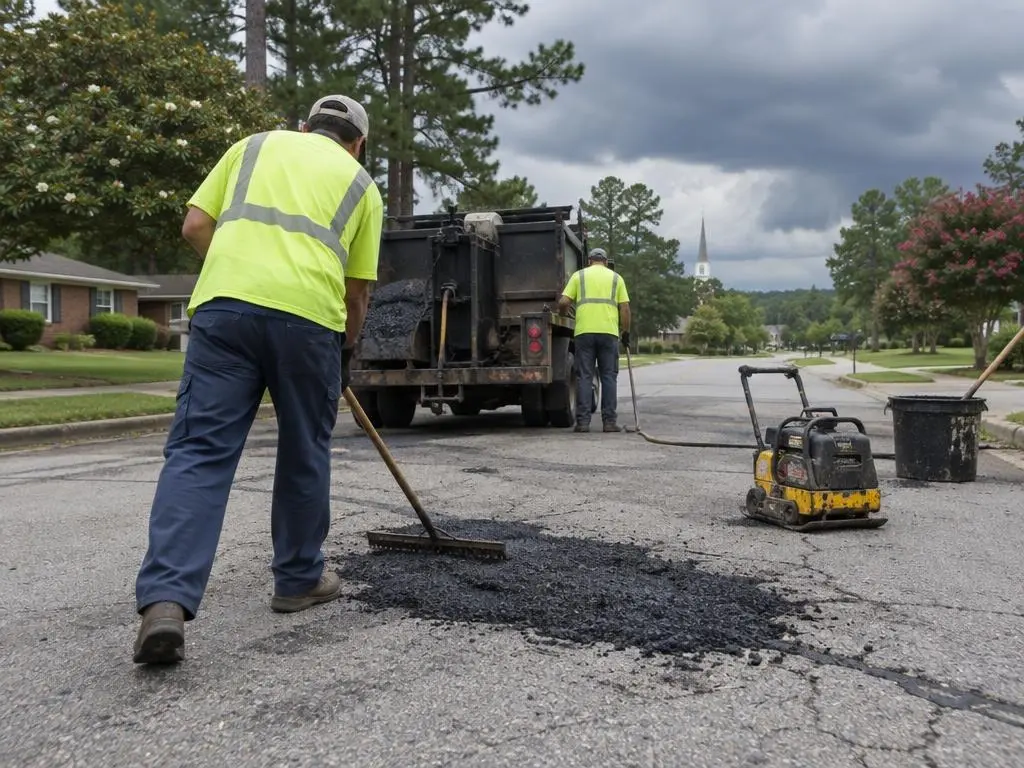
Why Homeowners Call Asphalt Paving Jackson
Clay first
Soft or heaving clay is dug out and replaced with compacted stone before any asphalt goes down.
Numbers in writing
Base depth and compacted asphalt thickness are stated for each area of the job.
Water planned for
Cross slope, edges and runoff paths are set so rain leaves the pavement instead of soaking the clay under it.
Permits sorted early
We tell you whether city, county or MDOT rules apply where your driveway meets the road.
Get an Asphalt Paving Estimate
Free on-site estimates in Jackson and across Hinds, Madison and Rankin counties.